IME report glossary
Plain definitions of terms you'll see in referrals, reports and vendor demos. Legal meanings and required wording vary by state and by program (workers' comp, auto, disability, liability). Check your jurisdiction's rules before relying on any definition here.
Limits: vendor facts come from vendor websites, read 2026-11-08, and were not tested by us. Prices change. How we checked.
Who owns each step matters more than the vocabulary. This table sorts the terms by who should decide them:
| Who decides | Terms | What software can do |
|---|---|---|
| The examiner | Causation, MMI, apportionment, impairment rating, work status | Show the cited facts; never write the opinion |
| The client | Referral questions, turnaround time, report format | Track deadlines and flag unanswered questions |
| The records | Chronology, gap in care, deduplication, page citation | Sort, deduplicate and cite every line to a page |
| The contract | BAA | Nothing: sign it before any upload |
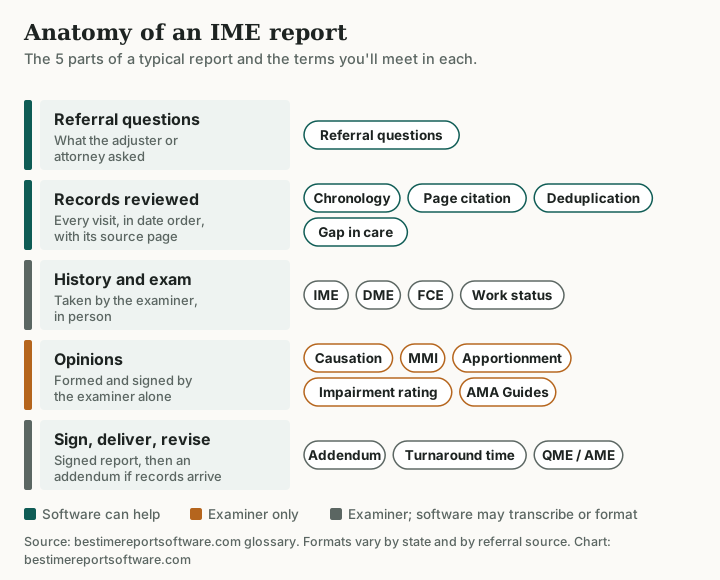
Exam and report terms
- IME
- Independent medical examination: an exam by a physician who isn't treating the person, requested by an insurer, employer, attorney or agency to answer specific questions.
- Defense medical exam (DME)
- A term used in some liability and auto cases for an exam requested by the defense. Often used loosely as a synonym for IME.
- Peer review
- A records-only review, without an exam, usually of whether treatment was reasonable and necessary.
- Referral questions
- The specific questions the client wants answered. A report that misses one usually comes back.
- Addendum
- A supplemental report written after the original, usually because new records arrived or the client asked a follow-up question.
- Turnaround time
- Days from exam to delivered report. Clients often set it by contract.
- Functional capacity evaluation (FCE)
- A structured test of what physical work a person can do. Often referenced in IME reports on work restrictions.
Opinion terms the examiner owns
- Causation
- The examiner's opinion on whether, and to what degree, the event in question caused the condition.
- Maximum medical improvement (MMI)
- The point where the condition is stable and further treatment isn't expected to improve it much.
- Apportionment
- Dividing responsibility for a condition or impairment between the work injury and other causes, such as a prior injury or degenerative change. Rules differ sharply by state.
- Impairment rating
- A percentage that expresses permanent loss of function, usually under the AMA Guides.
- AMA Guides
- The AMA Guides to the Evaluation of Permanent Impairment, the reference most jurisdictions use for impairment ratings. Which edition applies depends on the jurisdiction.
- Work status
- Whether the person can work, with or without restrictions, and what the restrictions are.
Records and software terms
- Record review
- Reading and summarizing the medical records before the exam or the report. Often the longest step.
- Chronology
- A date-ordered list of every encounter, test and finding in the records. Useful only if every entry points to its source page.
- Page citation
- A reference from a summary line back to the exact page in the records it came from. The single most useful feature in record review software.
- Deduplication
- Finding and removing repeated pages, such as the same note sent by 2 providers. Matters for price when software bills per page.
- Gap in care
- A stretch of time with no treatment. Examiners and adjusters both look for these.
- Optical character recognition (OCR)
- Software that turns a scanned page into text a computer can search. Handwritten notes and faxes come out worst, so check those pages by hand.
- Protected health information (PHI)
- Health data tied to a person, such as a claimant's records, that HIPAA protects. Any vendor that stores or processes PHI for you needs a BAA.
- Business Associate Agreement (BAA)
- The HIPAA contract a vendor signs before it may handle protected health information for a covered entity or its business associates. No BAA, no claimant records.
Roles: who does what in an IME
- IME company
- A vendor that takes referrals from clients, recruits and schedules examiners, and manages QA and delivery. Also called an IME vendor or panel.
- QME / AME
- In California workers' comp, a qualified medical evaluator or agreed medical evaluator. Other states have their own titles.
Acronyms on this site, spelled out
30 short forms that appear across this guide, in plain words.
| Acronym | Stands for |
|---|---|
| AI | Artificial intelligence. On this site it means software that reads records or drafts text. |
| QA | Quality assurance: checking a report for errors and missing answers before it goes out. |
| QC | Quality control. Used the same way as QA. |
| HIPAA | Health Insurance Portability and Accountability Act, the US law that protects health records. |
| SOC 2 | System and Organization Controls 2, an independent audit of a vendor's security controls. |
| EMR | Electronic medical record, the chart a practice keeps. |
| EHR | Electronic health record. Used much like EMR. |
| MRI | Magnetic resonance imaging. |
| CT | Computed tomography, a cross-section X-ray scan. |
| WC | Workers' compensation. |
| DWC | Division of Workers' Compensation. California and Texas each have one. |
| OMFS | Official Medical Fee Schedule, California's price list for medical services in workers' comp. |
| CCR | California Code of Regulations. Title 8 holds the workers' comp rules. |
| EAMS | Electronic Adjudication Management System, California DWC's case filing system. |
| TPA | Third-party administrator, a company that handles claims for an insurer or self-insured employer. |
| NAIC | National Association of Insurance Commissioners, the group of US state insurance regulators. |
| NDA | Non-disclosure agreement. |
| ICD-10 | International Classification of Diseases, 10th revision: the diagnosis codes. |
| CPT | Current Procedural Terminology: the procedure billing codes. |
| H&P | History and physical, the standard intake note. |
| ODG | Official Disability Guidelines, a commercial set of treatment and return-to-work guidelines. |
| MTG | Medical Treatment Guidelines. New York's workers' comp board publishes its own. |
| DBI | Diagnosis-based impairment, the rating grids in the AMA Guides 6th edition. |
| FECA | Federal Employees' Compensation Act, the workers' comp program for US federal staff. |
| PR-2 | California's progress report form for the primary treating physician. |
| PR-4 | California's permanent and stationary report form for the primary treating physician. |
| TLS | Transport Layer Security, the encryption that protects data in transit. |
| AES-256 | Advanced Encryption Standard with 256-bit keys, used to encrypt stored data. |
| GPU | Graphics processing unit, the chip that runs most AI models. |
| AWS | Amazon Web Services, a cloud hosting provider. |
Questions about IME terms
What's the difference between an IME and a peer review?
An IME includes an in-person exam. A peer review is records only, usually on whether treatment was reasonable and necessary.
Is a DME the same as an IME?
Close. DME (defense medical exam) is the term some liability and auto cases use for an exam the defense requests. People often use the 2 terms loosely as synonyms.
Which of these terms can software decide?
Software can decide none of the opinion terms: causation, MMI, apportionment and impairment stay with the examiner. IME software can build the chronology, remove duplicates and cite pages; see where AI helps.
Do these definitions hold in every state?
No. Legal meanings and required wording vary by state and by program; California's QME and AME titles are 1 example, so check your jurisdiction's rules.
What's the most useful feature in record review software?
The page citation: every summary line links to the page it came from, so you can verify it before you sign. The buyer's checklist turns it into a test.